
Managing hotel bookings across multiple online travel agencies (OTAs) can become a challenging task. Hotels listed on platforms like MakeMyTrip, Booking.com, Agoda and other booking websites need to regularly update room availability, manage prices and keep track of incoming reservations.
When all these activities are handled manually, hotel staff have to log in to different platforms, update room inventory separately and check each booking to make sure everything is in order. This takes time and increases the chances of human errors.
This is where a Channel Manager for hotels becomes useful.
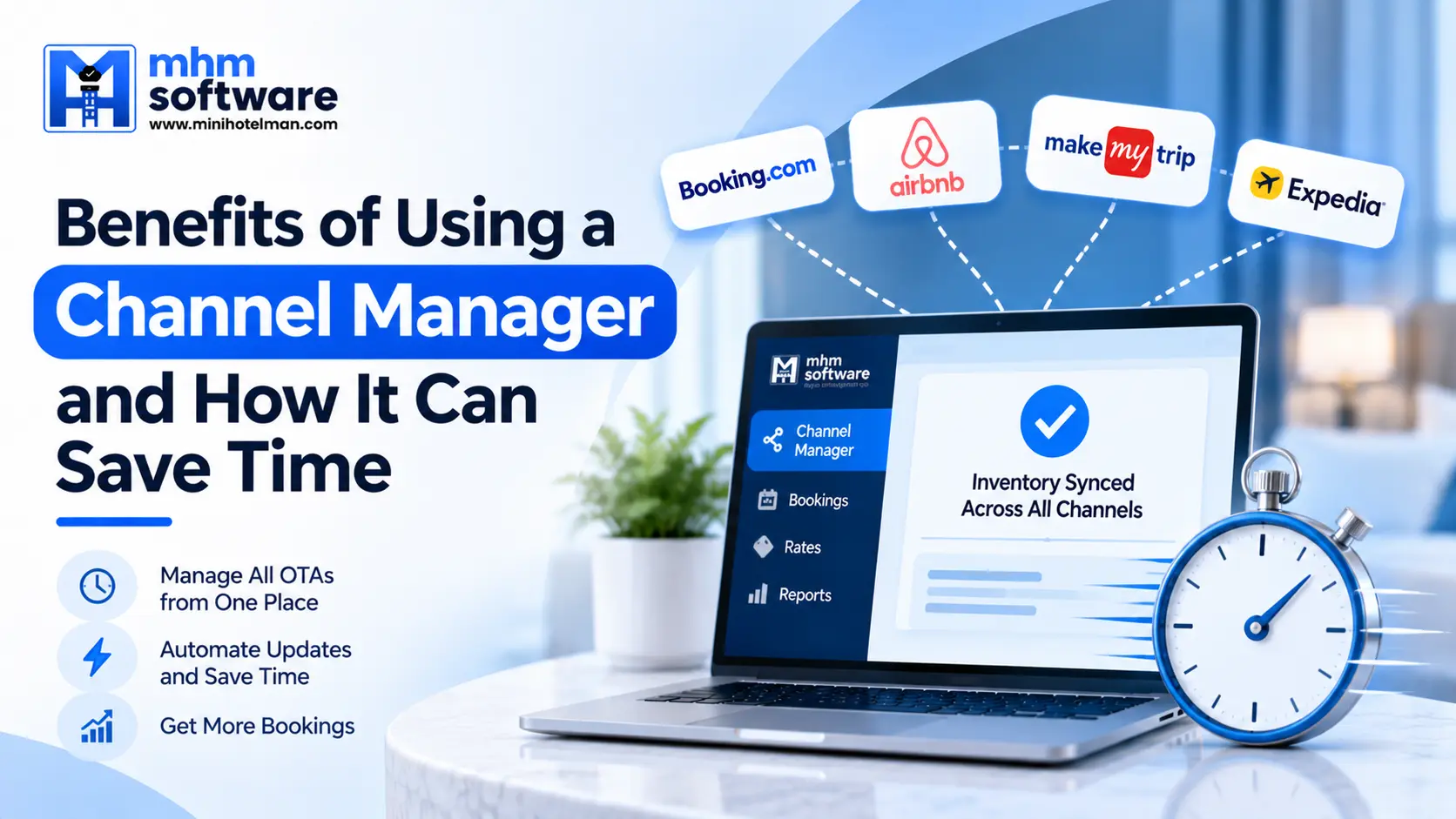
A Channel Manager helps hotels manage their room availability, rates and bookings across multiple online platforms through a single dashboard. Instead of making the same changes on every OTA separately, hotel staff can manage their connected channels from one place.
For small and mid-sized hotels, this can make everyday operations considerably easier.
In this blog, we will explore the major benefits of using hotel Channel Manager software, how it saves time and why it has become an important tool for hotels that depend on online bookings.
What Is a Channel Manager in the Hotel Industry?
A Channel Manager is software that helps hotels manage their room inventory, availability and pricing across multiple online booking platforms from one place.
Hotels often list their rooms on several OTAs to reach more potential guests. However, managing each platform separately can become difficult, especially when reservations, cancellations and room availability change throughout the day.
A Channel Manager connects these booking platforms and helps synchronise important information across them.
For example, imagine a hotel has 10 rooms available and receives a booking through one OTA. The Channel Manager updates the available inventory across the other connected platforms, so they reflect the latest room availability.
Similarly, if the hotel changes its room rates or blocks certain rooms, those updates can be sent to the connected platforms through the Channel Manager.
In simple terms, a Channel Manager helps hotels manage their online distribution without having to handle every booking platform separately.
Why Do Hotels Need a Channel Manager?
Today, hotels often depend on multiple online platforms to generate bookings. While being listed on different OTAs can improve a property’s online reach, managing them individually requires regular attention.
Consider a hotel listed on five different booking platforms. If the hotel receives a reservation, the staff may have to update availability on the remaining platforms manually. The same process needs to be repeated whenever a booking is cancelled, a room is blocked or the room tariff changes.
This can become a repetitive task.
A Channel Manager simplifies this process by centralising channel management and automating updates across connected platforms.
It helps hotels save time, manage inventory more efficiently and reduce the chances of overbooking.
7 Major Benefits of Using a Channel Manager for Hotels
Let’s look at how a hotel Channel Manager can make everyday operations easier.
1. Manage Multiple OTAs from One Dashboard
One of the biggest advantages of a Channel Manager is that hotels can manage multiple online booking platforms from a single dashboard.
Without a Channel Manager, staff may need to log in to every OTA separately to update room availability and pricing.
With a Channel Manager, these activities can be managed centrally.
For example, if a hotel wants to change its room tariff or update its available inventory, staff can make the change in the Channel Manager instead of repeating the same task across multiple platforms.
This makes OTA management much more convenient and saves considerable time.
2. Saves Time by Automating Inventory Updates
Manually updating room availability across different booking platforms can take up a significant part of the front desk or reservations team’s day.
A Channel Manager automates much of this work.
Whenever a room is booked or cancelled through a connected platform, the available inventory is updated across the other connected channels.
This reduces the need for staff to keep checking every OTA and making individual changes.
Instead of spending time on repetitive inventory updates, hotel employees can focus on guest enquiries, reservations and other important responsibilities.
3. Helps Prevent Overbooking
Overbooking is one of the most common problems hotels face when managing multiple online booking platforms manually.
For example, imagine a hotel has only one room left. If two guests book that room through different OTAs before the hotel staff manually update availability, the property may end up with two confirmed reservations for the same room.
A Channel Manager helps reduce this risk by synchronising room availability across connected platforms.
When a booking is received on one channel, the available inventory is automatically adjusted and updated on the others.
This helps hotels maintain more accurate room availability and avoid the complications associated with double bookings.
No system can guarantee that overbooking will never happen, but reliable synchronisation significantly reduces the risks caused by delayed manual updates.
4. Update Room Rates Across All Platforms Easily
Hotel room prices often change depending on the season, occupancy, weekends, festivals and local demand.
Updating these prices manually on every OTA can become a tedious task.
A Channel Manager allows hotels to manage their room rates centrally and distribute the changes across connected booking platforms.
For example, if a hotel decides to increase its weekend room tariff, staff can update the rate through the Channel Manager rather than logging in to each platform separately.
This makes rate management easier and helps hotels maintain consistent pricing information across their connected channels.
5. Makes Dynamic Pricing Easier
Not every day has the same demand for hotel rooms. Some dates attract more bookings, while others may have lower demand.
This is why many hotels use dynamic pricing to manage their room tariffs.
Dynamic pricing means adjusting room rates based on factors such as:
- Hotel occupancy.
- Seasonal demand.
- Weekends and public holidays.
- Local events and festivals.
- Booking trends.
- Market conditions and competitor pricing.
For example, a hotel located in a popular tourist destination may experience higher demand during holiday seasons. During these periods, it may choose to increase room rates. During slower periods, it may offer more competitive prices to attract bookings.
A Channel Manager with dynamic pricing functionality makes it easier to manage these rate changes and distribute updated prices across connected booking platforms.
It gives hotels greater flexibility when managing their pricing strategy.
6. Reduces Manual Errors and Improves Accuracy
When staff manage multiple OTAs manually, it is easy to forget an update or enter incorrect information.
A room may remain available on one platform even after being sold elsewhere. Similarly, room rates may differ across platforms because of delayed updates.
A Channel Manager reduces dependence on repetitive manual entries by helping synchronise availability and pricing information.
This improves the accuracy of online listings and makes channel management more organised.
7. Keeps Hotels Updated with Booking Notifications
Hotels need to stay informed whenever a new reservation arrives.
Without proper notifications, staff may have to keep checking different booking platforms to find out whether new bookings have been received.
A Channel Manager with booking notifications makes this easier.
For example, WhatsApp booking notifications can alert the hotel team whenever a new booking is received. This helps staff stay informed without repeatedly logging in to different OTA accounts.
It also makes it easier for hotel owners and managers to keep track of incoming reservations, even when they are away from the front desk.
How Does a Channel Manager Actually Save Time?
Let’s understand this with a simple example.
Imagine a hotel has 20 rooms and is listed on five different OTAs.
Without a Channel Manager, the staff may need to:
- Log in to five different OTA accounts.
- Check room availability on each platform.
- Update inventory after every reservation.
- Change room rates separately.
- Check for new bookings and cancellations.
- Make sure room availability is consistent everywhere.
These activities have to be repeated regularly.
With a Channel Manager, the hotel can manage connected platforms through one dashboard. Room availability and rates can be updated centrally, while incoming reservations are synchronised automatically.
This reduces repetitive work and gives hotel staff more time to focus on daily operations and guest requirements.
What Should You Look for When Choosing Hotel Channel Manager Software?
Before choosing a Channel Manager, hotel owners should consider a few important features.
1. Easy-to-use dashboard: The software should be simple enough for hotel employees to operate without complicated processes.
2. Fast inventory synchronisation: Updates to room availability should reach connected booking platforms quickly.
3. Rate management: Hotels should be able to manage room tariffs across different platforms from one place.
4. Dynamic pricing: Look for pricing functionality that supports flexible room-rate management according to your property’s requirements.
5. Booking notifications: Notifications through WhatsApp or other supported channels can help hotel staff stay updated about new reservations.
6. PMS integration: A Channel Manager that works with the hotel’s PMS can make reservation and inventory management more convenient.
7. Reliable customer support: Timely assistance is important when hotels need help managing their online distribution.
Choosing the right software can make OTA management easier and help hotels handle their online bookings more efficiently.
Simplify OTA Management with MiniHotelMan Channel Manager
Managing multiple booking platforms should not require hotel staff to spend hours updating room availability and checking reservations.
MiniHotelMan provides an easy-to-use and highly responsive Channel Manager designed to simplify online distribution for hotels.
Its user-friendly interface makes it easier for hotel owners and employees to manage their connected booking platforms without dealing with complicated processes.
Here is how MiniHotelMan Channel Manager helps hotels:
Easy-to-Use Channel Manager
MiniHotelMan provides a simple and user-friendly dashboard where hotels can manage their connected OTAs. Staff can handle important inventory and rate updates from one place instead of logging in to different platforms individually.
Highly Responsive Inventory Updates
Speed matters when managing online room availability. MiniHotelMan Channel Manager is designed to be highly responsive, with updates reflected on connected platforms within seconds.
When a new reservation is received or inventory is changed, the system helps ensure that the latest availability is communicated quickly across the connected platforms.
This helps reduce delays and lowers the risk of overbooking.
Dynamic Pricing Option
MiniHotelMan also provides a dynamic pricing option that gives hotels greater flexibility when managing room rates.
Hotels can use pricing adjustments to respond to changing demand and manage their room tariffs more effectively.
This is especially useful for properties that experience changes in demand during weekends, holidays, festivals and peak travel seasons.
WhatsApp Booking Notifications
MiniHotelMan offers WhatsApp notifications as an add-on feature.
Whenever the hotel receives a new booking, the concerned hotel contact can receive a WhatsApp notification with the booking alert.
This makes it easier for hotel owners and staff to stay informed about new reservations without constantly checking multiple OTA accounts.
Complete PMS and Channel Manager Synchronisation
MiniHotelMan also provides synchronisation between its PMS and Channel Manager, helping hotels manage their reservations and room inventory more conveniently.
When an offline reservation is created through the PMS, the available inventory is automatically adjusted and updated across connected platforms.
This reduces the need for repeated manual updates and helps keep room availability organised.
Whether you manage a small hotel, a resort, a homestay or a mid-sized property, MiniHotelMan helps simplify OTA management so your team can spend less time handling repetitive tasks and more time focusing on guests.
Frequently Asked Questions (FAQs)
1. What is a Channel Manager in the hotel industry?
A Channel Manager is software that helps hotels manage room availability, rates and reservations across multiple online travel agencies (OTAs) through a single dashboard. It automatically synchronises important updates across connected booking platforms.
2. What are the benefits of using a Channel Manager?
The main benefits include managing multiple OTAs from one place, saving time, reducing manual errors, keeping room availability updated, managing room rates and reducing the risk of overbooking.
3. How does a Channel Manager prevent overbooking?
A Channel Manager synchronises room inventory across connected booking platforms. When a room is booked on one OTA, the available inventory is automatically adjusted on the other connected platforms, reducing the chances of the same room being booked twice.
4. Do hotels use dynamic pricing?
Yes. Many hotels use dynamic pricing to adjust room rates according to demand, occupancy, seasonality, weekends, festivals, local events and market conditions. It helps hotels manage their pricing strategy according to changing booking demand rather than keeping the same room tariff throughout the year.
5. Can a Channel Manager update room rates automatically?
A Channel Manager allows hotels to update room rates centrally and distribute those changes across connected booking platforms. Some systems also provide dynamic pricing functionality to support demand based rate adjustments.
6. Can a Channel Manager send booking notifications on WhatsApp?
Yes, depending on the software and its available integrations. Some Channel Managers offer WhatsApp notifications that alert hotel owners or staff whenever a new reservation is received.
7. Is a Channel Manager useful for small hotels?
Absolutely. Small hotels often have limited staff who handle multiple responsibilities. A Channel Manager reduces the time spent updating different OTA platforms manually and makes online booking management easier.
8. What is the difference between a PMS and a Channel Manager?
A PMS (Property Management System) helps hotels manage daily operations such as reservations, guest check-in, check-out and billing. A Channel Manager focuses on managing room availability and rates across connected online booking platforms. When both systems are integrated, hotel operations and online distribution become easier to manage.
9. How do I choose the right Channel Manager for my hotel?
Look for a Channel Manager that is easy to use, offers fast inventory synchronisation, supports your preferred OTAs, provides convenient rate management and integrates with your PMS. Features such as dynamic pricing and booking notifications can also add value.
10. Can a Channel Manager save time for hotel staff?
Yes. It reduces the need to log in to multiple OTA accounts and manually update room availability and rates. This saves time, reduces repetitive work and allows staff to focus on other hotel responsibilities.
11. How can I prevent overbookings in my property?
The best way to prevent overbookings is to use a reliable Channel Manager that keeps your room availability updated across all connected OTAs. Whenever a booking is received on one platform, the available inventory should automatically adjust across the other connected platforms.
A responsive Channel Manager makes this process much easier. MiniHotelMan’s Channel Manager synchronises inventory updates with connected platforms within seconds. It also automatically adjusts availability when an offline reservation is created through its PMS, helping hotels reduce the risk of overbookings.
