

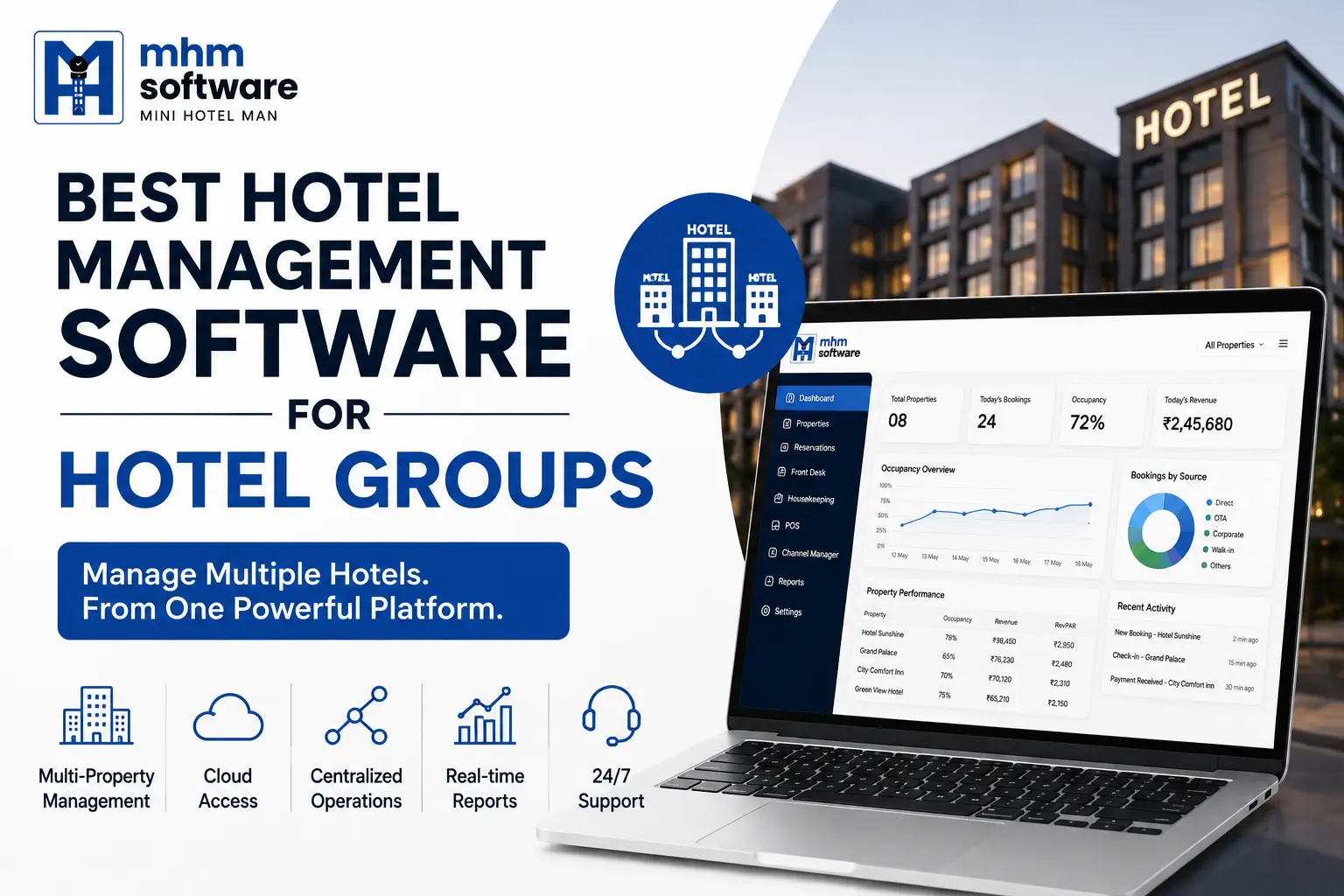
Running one hotel is challenging enough. When you start managing two, three or more properties, things can get complicated very quickly.
Bookings are coming from different OTAs. Each property has its own room inventory, rates and staff. Owners want to know how every hotel is performing, while managers need to take care of the day-to-day operations at their own property.
And if every hotel is using a different system, you can imagine the amount of work involved.
This is where hotel management software for hotel groups can make things much easier.
A good hotel PMS can bring your properties onto one connected platform, giving the management team better visibility while allowing each hotel to continue running its daily operations independently.
For small and mid-segment hotel groups in India, however, there is another important requirement: the software should actually be easy to use.
You don’t necessarily need a complicated enterprise system with hundreds of features that your team will rarely use. You need something that solves your everyday problems without creating new ones.
Why Do Hotel Groups Need a Different PMS?
A PMS that works perfectly well for one independent hotel may not be enough when you start operating multiple properties.
For example, an owner with four hotels may want to check the overall bookings without logging into four different systems. At the same time, the front desk team at each property needs to see its own reservations, rooms, guests and billing.
This is where multi-property hotel management software becomes useful.
Instead of treating every hotel as a completely separate operation, you can have a connected system where the relevant information is available to the people who need it.
It can make things such as:
- Checking bookings across properties
- Monitoring room availability
- Managing guest information
- Reviewing hotel reports
- Managing OTA inventory
- Checking revenue
- Supervising day-to-day operations
much easier.
What Should the Best Hotel Management Software for Hotel Groups Offer?
There isn’t one PMS that is automatically the “best” for every hotel group.
The right choice depends on the size of your group, how your properties operate and what your staff actually needs.
But if you’re comparing hotel PMS for hotel groups, these are the features I would look at first.
1. Multi-property management
This is obviously the first thing to check.
If you operate multiple hotels, your PMS should allow you to manage them through a connected system rather than forcing you to maintain completely separate workflows.
Ideally, management should be able to get an overall view while individual properties can continue managing their own reservations and operations.
2. It should be easy for your staff
This sounds obvious, but it is one of the biggest problems with hotel software.
A system can have every feature in the world, but if your front desk staff needs days of training to understand it, adoption becomes difficult.
For small and mid-segment hotel groups, ease of use is particularly important because teams are often smaller and staff members handle multiple responsibilities.
Your reception team should be able to understand the basics quickly – reservations, check-in, check-out, billing, room status and guest details.
3. Cloud-based access
If you are managing multiple hotels, you don’t want your business information sitting on computers that can only be accessed at one property.
A cloud-based hotel PMS gives authorised users the flexibility to access the system remotely.
An owner sitting in Delhi can check on a property in another city. A management team can review reports without physically visiting every hotel.
That flexibility becomes increasingly useful as your hotel group grows.
4. A proper Channel Manager
This is a big one.
Most hotel groups don’t depend on walk-ins alone. Their rooms are listed on platforms such as Booking.com, MakeMyTrip, Goibibo, Agoda, Airbnb and other OTAs.
Updating every OTA manually is a headache even for one property. With multiple hotels, it can become a full-time job.
A Hotel Channel Manager connects your property with supported OTAs and helps synchronise room availability and rates.
This reduces manual updating and, importantly, helps reduce the chances of an OTA booking creating an overbooking because the inventory wasn’t updated in time.
5. Property-level flexibility
Centralised management is useful, but your hotels aren’t necessarily identical.
One property might have a restaurant. Another might not.
One may have 20 rooms while another has 80.
Room categories, pricing, policies and services can also differ.
Your hotel management software for multiple properties should therefore give you central control without forcing every property into exactly the same setup.
6. PMS, POS and billing in the same ecosystem
Switching between different systems for reservations, billing and restaurant operations creates unnecessary work.
An integrated PMS and POS can connect your front desk and F&B operations.
For example, if a guest staying in Room 204 orders food from the hotel restaurant, the charge can be handled through the connected system rather than being maintained separately.
For hotel groups, having fewer disconnected systems can make operations considerably simpler.
7. Reports that owners can actually understand
You don’t need a report with 200 numbers just because the software can generate one.
Hotel owners generally want to understand things like:
- How many rooms are occupied?
- How many bookings came from OTAs?
- How much revenue did the property generate?
- What payments are pending?
- How are the different properties performing?
Good reporting should help you make decisions, not make you spend another hour figuring out what the report means.
MiniHotelMan for Hotel Groups and Multiple Properties
This is where MiniHotelMan takes a slightly different approach.
MiniHotelMan isn’t built primarily for huge five-star hotel chains with extremely complex enterprise requirements.
Our focus is on small and mid-segment hotels, budget hotels, boutique properties, guest houses, B&Bs, homestays and growing hotel groups that want proper technology without making their daily work complicated.
The platform brings important hotel operations together, including:
PMS for reservations, check-ins, check-outs, guest records, room management, billing and day-to-day operations.
Channel Manager to connect your properties with online travel agencies and manage rates and availability.
POS for restaurant and F&B operations.
Booking Engine to accept direct bookings through your website.
And for hotels that want more than software, MiniHotelMan also provides OTA Management Services and Revenue Management Services.
So instead of buying one product for PMS, another for the Channel Manager and then hiring someone separately to manage your OTAs, you can have these services under one ecosystem.
Managing Multiple Hotels Without Making Your Life More Complicated
The whole point of using a multi hotel management system is to make management easier.
As a hotel owner, you shouldn’t have to spend your day jumping between different dashboards just to find out what’s happening across your properties.
With MiniHotelMan, the idea is simple:
One platform. Multiple properties. Less manual work.
Your property teams can handle their daily hotel operations, while owners and management can maintain better visibility over the overall business.
And because every hotel is different, MiniHotelMan also provides free customisations so the software can be adapted to specific operational requirements.
Is MiniHotelMan Suitable for Hotel Chains?
It depends on what you mean by “hotel chain.”
If you’re talking about a large international chain with highly specialised enterprise requirements, a large enterprise PMS may be a better fit.
But if you’re an Indian hotelier who has started with one property and is now operating or expanding to multiple hotels, MiniHotelMan is built with businesses like yours in mind.
Whether you have a few independent properties under one group or are gradually building a hotel brand, having an easy-to-use hotel PMS for multiple properties can help you manage growth without adding unnecessary complexity.
Why Small and Mid-Segment Hotel Groups Choose Simpler Software
Technology adoption is often less about the number of features and more about whether the people using it actually like it.
A hotel group may have a great PMS on paper, but if the reception team finds it confusing, staff members may go back to Excel, WhatsApp messages and manual registers.
That’s exactly what hotel software is supposed to eliminate.
MiniHotelMan focuses on making the system practical for real hotel teams – from owners and managers to front desk staff.
You also get 24×7 support, because hotel operations don’t stop at 6 PM.
What Else Can a Hotel Group Do With MiniHotelMan?
Managing the PMS is only one part of growing a hotel group.
Once your properties are connected, you can also use MiniHotelMan’s other hotel technology and services to grow your business.
Increase OTA bookings
Our OTA Management Services help hotels manage their online presence across OTA platforms, including pricing, promotions, campaigns, visibility and regular OTA tasks.
Improve hotel revenue
Our Hotel Revenue Management Services focus on pricing and occupancy strategies to help properties make better use of available demand.
Increase direct bookings
Our Booking Engine allows guests to book directly with your hotel instead of depending entirely on OTAs.
Manage restaurant operations
The integrated POS helps manage restaurant orders, KOTs, billing and related operations.
So the objective isn’t simply to give you another PMS.
It’s to give your hotel group a connected technology ecosystem that can help you manage better and sell better.
How to Choose Hotel Management Software for Your Group
Before signing up for any hotel group management software, don’t just look at the feature list.
Ask the vendor to show you how the system actually works.
Check:
- Can I manage multiple properties?
- Can each hotel have its own room types and rates?
- Can my staff learn it easily?
- Is it cloud-based?
- Does it have a Channel Manager?
- Which OTAs does it connect with?
- Can I manage billing and POS?
- Can I get reports across properties?
- Can the software be customised?
- What happens when I need support?
- What will the actual total cost be?
And most importantly:
Ask your front desk team to try it.
They’re the people who will use the PMS every day.
If they find it difficult, it probably isn’t the right software for your hotel group.
Final Thoughts
Growing from one hotel to multiple properties is exciting, but it also brings a completely different set of operational challenges.
The right hotel management software for hotel groups can help you bring those operations together without taking away the flexibility each property needs.
For small and mid-segment hotel groups, the ideal system should be easy to use, cloud-based, affordable, connected to OTAs and supported by a team that understands hotel operations.
That’s exactly the segment MiniHotelMan focuses on.
If you’re managing multiple hotels or planning to expand your hotel business, you can book a free demo with MiniHotelMan and see whether our multi-property PMS, Channel Manager, POS, Booking Engine, OTA Management and Revenue Management Services are right for your properties.
Frequently Asked Questions
What is the best hotel management software for hotel groups?
The best hotel management software for a hotel group depends on the group’s size and requirements. For small and mid-segment hotel groups, look for a PMS that supports multiple properties, is easy to use, cloud-based, integrates with OTAs and provides reliable support.
What is multi-property hotel management software?
Multi-property hotel management software allows an owner or management team to manage multiple hotels through a connected PMS instead of operating completely separate systems for each property.
Can one PMS manage multiple hotels?
Yes. Many modern cloud-based PMS platforms support multiple properties. However, features such as centralised reporting, property-level controls and multi-property management differ between providers.
What is the difference between a hotel PMS and hotel chain management software?
A Hotel PMS manages everyday operations such as reservations, rooms, guests, billing and check-ins. Hotel chain or group management software adds capabilities for managing multiple properties and gives management better centralised visibility.
Can a hotel group manage Booking.com and MakeMyTrip from one system?
Yes, if the PMS has an integrated Channel Manager with those OTA connections. A Channel Manager can help synchronise availability and rates across supported OTAs and reduce manual updates.
Is cloud-based PMS good for multiple hotels?
Yes. A cloud-based PMS is particularly useful for multi-property businesses because authorised owners and managers can access property information remotely rather than being dependent on a computer at each hotel.
Is MiniHotelMan suitable for hotel groups?
MiniHotelMan is designed primarily for small and mid-segment hotels, budget properties, boutique hotels, guest houses, B&Bs, homestays and growing hotel groups. It provides PMS, Channel Manager, POS, Booking Engine, OTA Management and Revenue Management solutions.
Can MiniHotelMan manage different properties separately?
Yes. Hotel groups can manage their properties through the connected MiniHotelMan ecosystem while maintaining property-specific operational requirements.
Can hotel management software help a hotel group increase bookings?
The PMS itself manages operations, while connected tools such as a Channel Manager, Booking Engine, OTA Management Services and Revenue Management Services can help a hotel group improve distribution, direct bookings, OTA performance and revenue.

Anhad is Tech Founder Solving Real Problems for Small & Mid-Segment Hotels