
If you own or manage a hotel, you have probably come across three terms while exploring hotel management software: PMS, Channel Manager and Booking Engine.
Although these terms are often used together, they do not perform the same functions.
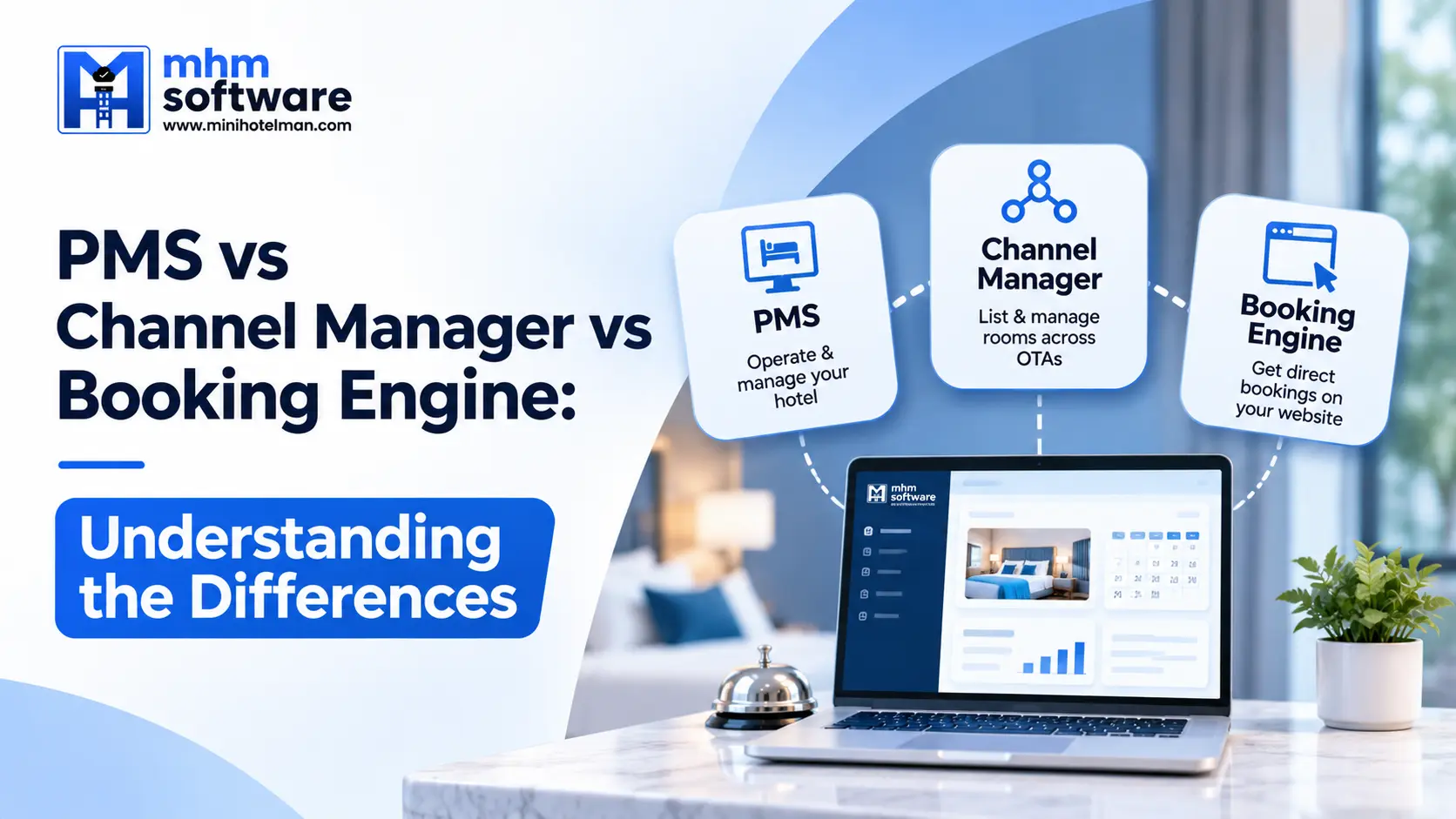
A Property Management System (PMS) helps you manage your hotel’s daily operations. A Channel Manager helps you manage room availability and rates across different online travel agencies (OTAs), while a Booking Engine allows guests to book rooms directly through your hotel’s website.
So, do you need all three? Can they work together? And what should you look for when choosing hotel management software?
Understanding the difference between PMS vs Channel Manager vs Booking Engine is important before investing in any hotel technology.
In this guide, we will explain what each system does, how they are different, and why choosing an integrated, cloud-based hotel management solution can make your daily operations easier.
What Is a Hotel PMS (Property Management System)?
A Property Management System, commonly known as a PMS, is software that helps hotels manage their day-to-day operations from a centralised platform.
Think of it as the main control centre of your hotel.
From managing reservations and checking guests in to handling billing, housekeeping and reports, a hotel PMS brings important operational activities together.
A cloud-based hotel PMS allows authorised users to access hotel information from different devices through an internet connection. This means you do not have to depend on a single computer or maintain separate offline records.
Important features of hotel PMS software include:
- Reservation Management: Create, modify, cancel and manage room bookings from one place.
- Front Desk Management: Handle guest check-ins, check-outs and room allocation.
- Billing and Invoicing: Generate guest bills, manage payments and maintain transaction records.
- Housekeeping Management: Monitor room status and coordinate cleaning activities.
- Guest Management: Maintain guest information and booking history.
- Staff Management: Manage employee records and attendance.
- Reports and Analytics: View occupancy, room revenue, sales and other important reports.
- POS Integration: Manage restaurant orders, food billing and room service.
For example, imagine a guest walks into your hotel for a two-night stay. Your front desk team can create a reservation, allocate a room, record guest details, manage payments and generate an invoice through the PMS.
Everything is maintained in one system instead of depending on registers and spreadsheets.
In simple words: A PMS manages the internal operations of your hotel and helps your team run the property efficiently.
What Is a Hotel Channel Manager?
A Hotel Channel Manager is software that helps hotels manage their room inventory, availability and rates across multiple online travel agencies.
If your hotel is listed on platforms such as MakeMyTrip, Goibibo, Booking.com, Agoda or Expedia, you already know how difficult it can be to manage multiple OTA accounts manually.
Imagine you have 25 rooms in your hotel and receive bookings through five different OTAs.
A guest books a room through MakeMyTrip. Now, you need to make sure the same room is no longer available on Goibibo, Booking.com, Agoda and Expedia.
If you update availability manually on every platform, you may forget to update one of them. This can result in duplicate bookings, commonly known as overbooking.
A Channel Manager solves this problem by connecting your hotel with multiple booking platforms and synchronising availability and rates.
Important features of a Hotel Channel Manager include:
- OTA Connectivity: Connect your hotel with multiple online travel agencies.
- Inventory Management: Manage room availability across connected platforms.
- Rate Management: Update room prices from a centralised dashboard.
- Reservation Synchronisation: Receive OTA bookings and reflect them in your central reservation system.
- Overbooking Prevention: Reduce the chances of selling the same room twice.
- Restriction Management: Manage booking restrictions such as minimum length of stay, where supported.
- Centralised Management: Avoid logging into multiple OTA extranets to update rates and availability.
Example:
Suppose a guest books your Deluxe Room through Booking.com.
Once the reservation is received and processed by your connected system, the Channel Manager updates the availability of that room across the other connected OTAs.
Your hotel staff do not have to manually update every platform.
In simple words: A Channel Manager manages your hotel’s online distribution by keeping room availability and rates synchronised across connected booking platforms.
What Is a Hotel Booking Engine?
A Hotel Booking Engine is a software application that allows guests to check room availability and make reservations directly through your hotel’s website.
Think about the last time you booked a hotel online.
You visited the hotel’s website, selected your check-in and check-out dates, checked available rooms, selected a room category and completed your booking.
That entire booking process was handled by a Booking Engine.
Unlike OTAs, where hotels receive bookings through third-party platforms, a Booking Engine helps hotels generate direct bookings through their own websites.
Important features of a Hotel Booking Engine include:
- Live Room Availability: Allow guests to check available rooms for their selected dates.
- Room Selection: Display room categories, rates and relevant details.
- Online Reservations: Allow guests to book rooms without calling the hotel.
- Online Payments: Accept advance payments through supported payment gateways.
- Booking Confirmation: Provide guests with booking confirmation and details.
- Website Integration: Integrate the booking facility into the hotel’s official website.
- Direct Booking Opportunities: Help hotels encourage guests to book directly instead of relying entirely on OTAs.
Example:
Imagine a traveller searches for your hotel on Google and visits your official website.
Instead of calling the reception to enquire about room availability, the traveller can select the dates, view available rooms, choose a suitable rate and complete the reservation online.
The hotel receives a direct booking without the guest having to book through an OTA.
This helps hotels build their direct booking channel and reduce dependence on third-party booking platforms.
In simple words: A Booking Engine helps your hotel receive direct online reservations through its own website.
PMS vs Channel Manager vs Booking Engine: What Is the Difference?
Now that we understand what each system does, let’s compare them side by side.
Although all three systems are connected to hotel reservations, their primary functions are different.
The Easiest Way to Remember the Difference
- PMS = Run your hotel.
- Channel Manager = Manage your OTAs.
- Booking Engine = Get direct bookings.
All three solve different problems. However, when they are properly integrated, they can work together as one connected hotel management system.
How Do PMS, Channel Manager and Booking Engine Work Together?
This is where things get interesting.
Although these three systems have different responsibilities, they become much more useful when they are connected.
Let’s understand this with a practical example.
Suppose you own a hotel with 30 rooms. Your property receives bookings through MakeMyTrip, Booking.com, Goibibo and its own official website.
You have a PMS, an integrated Channel Manager and a Booking Engine.
Here is how they work together:
Step 1: Your PMS maintains room information
Your PMS maintains the hotel’s room inventory, reservations, room categories, availability and rates.
Step 2: Your Channel Manager distributes room availability
Your Channel Manager connects your hotel with different OTAs and helps distribute your room availability and rates across the connected platforms.
Step 3: Your Booking Engine accepts direct reservations
A guest visits your hotel’s website, checks availability and books a room directly through your Booking Engine.
Step 4: The reservation is reflected in your connected system
The direct booking is transferred to the PMS, updating the hotel’s reservation records and availability.
Step 5: The Channel Manager updates the connected OTAs
The updated availability is distributed across the connected booking platforms, reducing the chances of duplicate bookings.
The same process works when a reservation comes from a connected OTA. The booking is reflected in the PMS, and the Channel Manager updates availability across the other connected channels.
This is why proper integration between a PMS and Channel Manager is so important.
When these systems are connected properly, hotel staff do not have to enter the same booking details multiple times or manually update room availability across different platforms.
It saves time, reduces manual work and makes reservation management much easier.
Why Should You Choose Cloud-Based Hotel Management Software?
While comparing PMS, Channel Manager and Booking Engine solutions, there is one more important factor you should consider: whether the software is cloud-based.
Traditional offline hotel software is generally installed on a particular computer or local server. This can make remote access and centralised management difficult.
A cloud-based hotel management system gives authorised users access to their property information through an internet-connected device.
Here is why cloud-based hotel software is a better fit for modern hotel operations:
- Access from Anywhere: Monitor reservations, occupancy and reports even when you are away from your property.
- Centralised Information: Keep your important hotel information in one system.
- Easier Management: Allow authorised team members to access updated information across devices.
- Less Dependence on Local Systems: Avoid relying entirely on one computer or local server.
- Simpler Software Updates: Benefit from provider-managed updates without handling traditional local installations.
- Better Operational Visibility: Stay informed about your property’s daily activities remotely.
For hotel owners managing their properties from different locations, cloud-based hotel PMS software offers greater flexibility and convenience.
Before selecting a provider, always check its data security, backup policies, user access controls and internet connectivity requirements.
Why Is an Integrated PMS and Channel Manager Important for Hotels?
Having a PMS and Channel Manager is useful, but having them properly integrated is even more important.
Some hotels use separate software solutions for managing reservations and OTA distribution. Although this arrangement can work, it may involve additional coordination and dependence on third-party integrations.
For example, when a booking comes through an OTA, your staff should not have to manually enter the same reservation into the PMS.
Similarly, when a room is booked directly through the front desk, its availability should be updated across the connected OTAs.
A properly integrated PMS and Channel Manager help automate these processes.
Here are some important benefits of complete synchronisation:
- Less Manual Work: Reservations are transferred between connected systems without repeated manual entry.
- Reduced Chances of Overbooking: Room availability is updated across connected channels.
- Better Inventory Management: Monitor your room inventory from one centralised system.
- Time Efficiency: Your staff can focus more on guests instead of updating multiple dashboards.
- Fewer Operational Errors: Reduce mistakes caused by manual updates and duplicate data entry.
- Better Control: Manage reservations and OTA availability through a connected workflow.
For small and mid-sized hotels, this integration is particularly useful because front desk teams often handle multiple responsibilities.
Instead of spending time switching between different software applications, they can manage their daily work more efficiently.
Why Choose MiniHotelMan? One Integrated Platform for Your Hotel
Now that you understand the differences between a PMS, Channel Manager and Booking Engine, the next question is: Do you really need three separate software solutions?
Not necessarily.
If you can manage these important functions through one integrated, cloud-based hotel management platform, why complicate your operations with multiple systems?
This is where MiniHotelMan comes in.
MiniHotelMan offers an all-in-one, cloud-based hotel management solution that integrates PMS, Channel Manager, Booking Engine and POS capabilities to simplify hotel operations.
Designed for small and mid-segment hotels across India, our platform helps hoteliers manage their property without depending on multiple disconnected applications.
1. Cloud-Based Hotel PMS
Manage your hotel’s reservations, room availability, guest details, check-ins, check-outs, billing and reports from a centralised platform.
Access your property information through an internet-connected device, even when you are away from the hotel.
2. Integrated Channel Manager
Manage your online distribution through one dashboard.
Connect with popular OTAs such as MakeMyTrip, Goibibo, Booking.com, Agoda, Expedia and other supported booking platforms.
Update room availability and rates through a centralised system instead of manually managing multiple OTA extranets.
3. Complete Synchronisation Between PMS and Channel Manager
This is one of the biggest advantages of using MiniHotelMan.
Our PMS and Channel Manager work together to keep reservation information and room availability synchronised across connected channels.
When a booking is received through an OTA, the reservation is reflected in the PMS. Similarly, when a reservation is created through the PMS, the updated availability can be distributed to connected OTAs through the Channel Manager.
This eliminates unnecessary manual work, reduces the chances of booking errors and saves valuable time for your hotel staff.
No more repeatedly entering booking details. No more switching between multiple dashboards just to update room availability.
4. Integrated Booking Engine
Give travellers the convenience of checking room availability and making reservations through your hotel’s own website.
With a direct booking facility, you can encourage guests to book with your property directly and build your hotel’s own online booking channel.
5. POS and Restaurant Management
Manage restaurant orders, room service, food billing and stock-related activities through an integrated POS solution.
Bring your hotel and restaurant operations closer together.
6. Revenue Management Solutions
Managing room rates is just as important as managing reservations.
MiniHotelMan also offers revenue management solutions to help hotels make better pricing decisions and improve their revenue opportunities.
7. Affordable and Easy to Use
Advanced hotel technology should not be limited to large hotel chains.
MiniHotelMan is designed to make integrated hotel management software accessible to small and mid-segment properties through affordable pricing and a user-friendly interface.
8. Customisations and 24×7 Support
Every hotel has different operational requirements.
MiniHotelMan offers customisations to suit individual property needs, along with round-the-clock customer support to assist hotel teams.
The Bottom Line
A PMS, Channel Manager and Booking Engine are not alternatives to one another. Each performs a different role in managing and growing your hotel’s business.
A PMS helps you manage daily operations, a Channel Manager keeps your OTA inventory and rates synchronised, and a Booking Engine helps you receive direct reservations.
However, managing these tools separately can create unnecessary complexity.
With MiniHotelMan, you get an integrated, cloud-based solution that brings these important functions together.
Whether you operate a budget hotel, boutique hotel, resort, guesthouse or homestay, MiniHotelMan helps you simplify daily operations and manage your online bookings more efficiently.
Stop managing multiple systems. Start managing your hotel smarter with MiniHotelMan.
Visit MiniHotelMan and book a personalised demo to explore our hotel PMS, Channel Manager and Booking Engine.
Frequently Asked Questions (FAQs)
1. What is the difference between PMS, Channel Manager and Booking Engine?
A PMS manages a hotel’s internal operations, including reservations, check-ins, check-outs, billing and housekeeping. A Channel Manager synchronises room availability and rates across OTAs. A Booking Engine allows guests to make direct reservations through the hotel’s website.
2. Do hotels need both a PMS and a Channel Manager?
Hotels that receive bookings through multiple OTAs can benefit from having both. A PMS manages internal reservations and hotel operations, while a Channel Manager updates room availability and rates across connected booking platforms.
3. Can a PMS and Channel Manager work together?
Yes. When integrated, the PMS and Channel Manager exchange reservation and inventory information. OTA bookings can be reflected in the PMS, while updated room availability can be distributed across connected booking platforms.
4. What is the purpose of a hotel Booking Engine?
A hotel Booking Engine allows travellers to check room availability, select room categories and make reservations directly through a hotel’s official website. It helps hotels build their direct booking channel and reduce dependence on OTAs.
5. What is the difference between a Channel Manager and an OTA?
An OTA is an online travel agency, such as MakeMyTrip, Booking.com or Agoda, where travellers search for and book accommodation. A Channel Manager is the software that connects hotels to multiple OTAs and helps synchronise their room availability and rates.
6. Is cloud-based hotel management software better than offline software?
Cloud-based hotel software allows authorised users to access hotel information from anywhere through an internet connection. It also makes centralised management easier and reduces dependence on a single computer or local server.
7. Can I manage PMS and Channel Manager through one software?
Yes. Some all-in-one hotel management platforms integrate PMS and Channel Manager functionalities into one system. This allows hotels to manage internal reservations and OTA distribution through a connected platform.
8. Which is the best integrated hotel management software in India?
The best solution depends on your property’s requirements, size and budget. Look for cloud-based software that combines PMS, Channel Manager, Booking Engine, billing, reporting and reliable customer support. MiniHotelMan offers an integrated hotel management solution designed for small and mid-segment hotels in India.
